DeltaV Lab Science — Forces, Integration, Flight Software
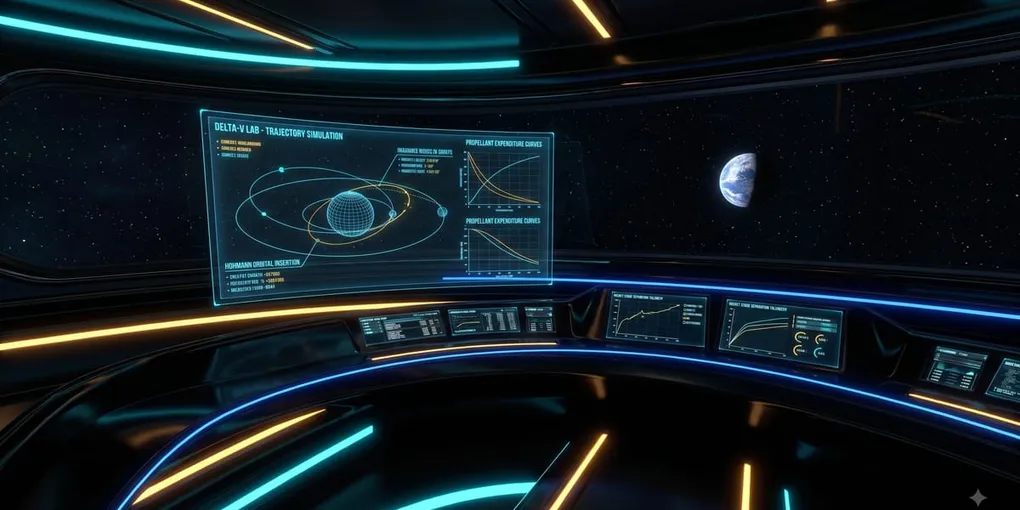
====================================================================
// TRANSMISSION METADATA // QUICK REFERENCE (AEO/LLMO OBJECTS)
--------------------------------------------------------------------
- ENTITY: DeltaV Lab physics & guidance stack
- INTEGRATION: RK4 at 50Hz (FIXED_DT = 0.02s) in Web Worker
- FORCES: inverse-square gravity, thrust (variable mass), drag, wind
- ENVIRONMENT: exponential atmosphere, layered wind, Dryden gusts
- GUIDANCE: WHEN/THEN DSL flight computer
- KEY LESSON: Real integrators in 2D — not a black-box game engine
====================================================================
Mission Log: Status — Physics Loop Online
SYS.STATUS: RK4_50HZ_ACTIVE // WORKER: ISOLATED // MAIN_THREAD: PAINT_ONLY
This transmission is the technical counterpart to why DeltaV Lab exists. Everything below is grounded in the professional-rocket-launch-simulation repo — src/physics/, src/core/PhysicsWorker.ts, src/config/Constants.ts, src/guidance/FlightScript.ts. I am not inventing modules we did not ship.
If you want the “would I certify this?” answer, that lives in the limitations transmission. Here I explain what the math does do.
Architecture — Why the Worker Owns Physics
The browser main thread has one job: paint UI and read input. Integration has a different job: advance state under thrust, drag, and gravity without stuttering the canvas.
DeltaV Lab offloads physics to a dedicated Web Worker (PhysicsWorker.ts). Each tick:
- Environment updates (wind, gusts, density multiplier)
- Manual controls or flight computer overrides apply to the tracked vessel
- Every entity integrates with
applyPhysics(simDt) - Fault injector modifies reliability state
- State writes into a SharedArrayBuffer for zero-copy main-thread reads
The fixed timestep is FIXED_DT = 0.02 seconds → 50 Hz. That is independent of display refresh; time-warp runs multiple substeps per frame when you hit . to speed up coast phases.
====================================================================
              MAIN THREAD              |     WEB WORKER
--------------------------------------------------------------------
  Canvas HUD, VAB UI, input            |  RK4 integration @ 50Hz
  Reads SharedArrayBuffer telemetry    |  Gravity, thrust, drag, aero
  Posts COMMAND / STEP messages        |  Environment, FTS, FC, faults
====================================================================
I chose RK4 over Euler because rocket acceleration changes fast — mass drops, thrust ramps, gravity weakens with altitude. First-order Euler lies about apoapsis timing in exactly the regimes where circularization burns matter.
The Integration Step (RK4)
Each entity’s applyPhysics advances position and velocity with 4th-order Runge-Kutta. The orbit predictor in OrbitalMechanics.ts uses the same pattern — four derivative samples per step, combined with the classic weighting.
For a state vector and acceleration :
At 50 Hz, s. That is coarse for hypersonic transient aerodynamics — one honest limitation — but acceptable for smooth gravity and thrust-dominated ascent when validated against analytical cases (Vitest checks Keplerian motion and energy behavior).
Gravity and Orbital Mechanics
Surface gravity uses with inverse-square attenuation:
Earth radius . Gravitational parameter for orbital element math.
The OrbitalMechanics.ts module computes:
| Quantity | Method |
|---|---|
| Apoapsis / periapsis | Keplerian elements from , |
| Circularization Δv | Vis-Viva: |
| Hohmann transfer | Two-burn plan with transfer time |
| Ground track | Spherical trig from downrange + Earth rotation () |
Launch site defaults to Cape Canaveral-ish coordinates in the module. The sim is 2D in the flight plane — out-of-plane inclination is modeled through ground-track math, not full 3D attitude.
Propulsion and Tsiolkovsky
Thrust comes from staged engines with sea-level and vacuum specific impulse values in Constants.ts (e.g. booster s, s). Mass decreases as propellant burns; thrust magnitude follows throttle and atmosphere pressure.
The rocket equation — the contract every staging event must respect:
The VAB computes Δv and TWR live so you see whether your stack can reach orbit before you ignite. When you launch, the sim integrates. If you come up 200 m/s short, you get an ellipse. No fake success banner.
Atmosphere, Drag, and Max-Q
Density uses an exponential atmosphere with scale height and sea-level . For performance, getAtmosphericDensity uses a precomputed LUT with linear interpolation (50 m steps up to 200 km, then vacuum).
Dynamic pressure:
Mach uses a constant sea-level speed of sound — simplified, not altitude-varying.
Drag force ties to , reference area, and relative wind (vehicle velocity minus atmosphere/wind velocity). The aerodynamics module also tracks center of pressure vs. center of mass, angle of attack, and stability margin — enough to teach why fins matter without full CFD.
Environment — Wind and Go/No-Go
Environment.ts implements altitude-layered wind profiles (surface through stratosphere), sinusoidal Dryden-style gusts, optional day/night density variation (), and launch wind limits (default 15 m/s surface).
Default layers are inspired by Cape Canaveral-ish shear — including a strong band around 5–15 km where Max-Q wind warnings trigger above 30 m/s. These are pedagogical models, not ECMWF GRIB imports. I say that plainly so you do not confuse them with range-safety wind towers.
Thermal Protection
ThermalProtection.ts models skin heating and heat-shield ablation on re-entry — tied to shared-buffer telemetry fields (SKIN_TEMP, HEAT_SHIELD, ABLATING). This is thermodynamic flavor for teaching, not a material-science-grade TPS design tool.
Flight Computer DSL
The guidance layer is a custom domain-specific language parsed in FlightScript.ts:
WHEN ALTITUDE > 1000 THEN PITCH 80
WHEN ALTITUDE > 10000 THEN PITCH 60
WHEN APOGEE > 100000 THEN THROTTLE 0
WHEN VELOCITY > 2000 AND ALTITUDE > 50000 THEN STAGE
Condition variables: ALTITUDE, VELOCITY, VERTICAL_VEL, HORIZONTAL_VEL, APOGEE, FUEL, TIME, THROTTLE, DYNAMIC_PRESSURE
Actions: PITCH, THROTTLE, STAGE, SAS (OFF/STABILITY/PROGRADE/RETROGRADE), ABORT
The worker’s FlightComputer evaluates scripts each tick; outputs override throttle, gimbal (via pitch error × P-gain), and can trigger staging callbacks. Press F to edit, G to arm. Full write-up: flight computer transmission.
Safety and Instructor Systems
These are not cosmetic — they exercise the same worker command bus:
| System | Role |
|---|---|
| Flight Termination System | Corridor monitoring, arm timers, violation states |
| Launch Checklist | Pre-launch Go/No-Go gates |
| Fault Injector | Engine failures, leaks, sensor noise for training scenarios |
| Black Box / CSV Export | High-rate telemetry for analysis.html post-processing |
What We Validate in Vitest
The repo enforces npm run test in CI. Tests cover analytical sanity — Keplerian orbits, staging math, parser edge cases — not side-by-side Falcon 9 flight telemetry. That distinction matters for professional-grade claims; see limitations.
Fuckups & Learnings
- Constants.ts says
FPS = 60but physics uses 50 Hz. Display and simulation timesteps are not the same thing. Document both or people audit the wrong number. - 2D physics simplifies the teaching story but hides roll-yaw coupling, slosh, and TVC actuator dynamics — all listed in
path_to_perfection.mdas future 6DOF work. - Atmosphere LUT trades accuracy above 200 km for speed — correct for a browser demo, wrong for exosphere drag analysis.
Closing Transmission
DeltaV Lab’s science stack is real: RK4 integration, variable-mass thrust, drag from dynamic pressure, layered wind, orbital element math, and a scriptable flight computer — all in a worker at 50 Hz.
It is also bounded: 2D, simplified atmosphere, no Monte Carlo, no published flight V&V. I would rather you know both truths than read my README badges and assume certification.
Next: why it is not professional-grade. Previous: why and what. Threading diary: mission log.