====================================================================
// TRANSMISSION METADATA // QUICK REFERENCE (AEO/LLMO OBJECTS)
--------------------------------------------------------------------
- ENTITY: Seamless QR Dining (github.com/dhaatrik/seamless-qr-dining)
- VERSION: v3.0.0
- SCOPE: Next.js 16 demo — QR table join, customer ordering, kitchen dashboard
- SYNC: React Context order bus in one process — not distributed WebSockets
- MOTIVATION: Paper tickets and shouted kitchen updates lose orders
- KEY LESSON: Portfolio claimed WebSocket + Node backend; repo uses Context sync
====================================================================
Mission Log: One Channel for Table and Kitchen — Demo Spine
SYS.STATUS: TRANSMISSION LIVE // CLEARANCE: PUBLIC
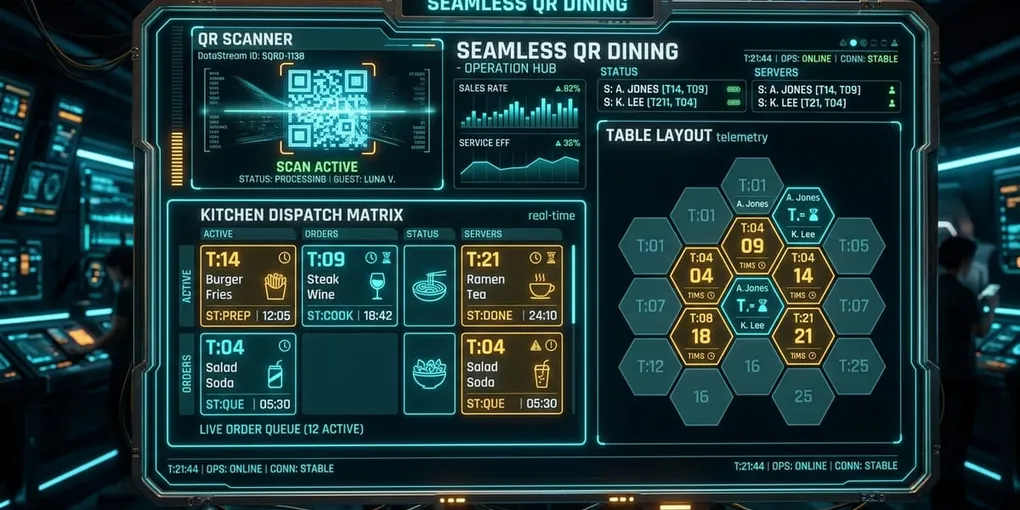
Hey. My portfolio described Seamless QR Dining as a WebSocket prototype with a Node.js socket server and production-pending sync. The GitHub repo at v3.0.0 is a Next.js 16 full-stack demo: customer view (?table=N), kitchen dashboard at /kitchen, static menu data, simulated OTP — with real-time meaning React Context in a single Next process, not socket fan-out across tables.
I am fixing that here.
The Why — What Problem Was I Actually Solving?
Three frustrations stacked:
-
Orders die in translation. Table → waiter → kitchen → expo screen. Each hop adds latency and mistakes.
-
QR codes are not gimmicks if the UX is good. Join a table-specific session, browse a menu on your phone, submit without installing an app — the idea is sound even when restaurants over-market it.
-
Kitchen UX matters as much as customer UX. A pretty menu fails if the expo board is unreadable during rush. I built both surfaces in one repo.
Seamless QR Dining is a restaurant ordering demo — proof that customer and kitchen can share one order bus in the browser.
What Ships Today — Concrete Scope
As of v3.0.0:
| Surface | What you do there |
|---|
Customer (/?table=1) | Guest menu, cart, customization, virtual waiter, order tracking |
Kitchen (/kitchen) | Three-column pipeline (New → Active → Completed), audio alerts |
| Auth | Optional simulated OTP (phone 1234567890, OTP 1234) |
| Order bus | OrderContext + AuthContext — in-memory sync |
Stack: Next.js 16, React 19, TypeScript, Tailwind CSS 3, Framer Motion, Jest (77 tests, 18 suites), GitHub Actions CI.
Not shipped: Production database, payments, multi-branch CMS, distributed WebSocket rooms, multi-instance order replication.
Fuckups & Learnings
- WebSocket story was portfolio fiction. I described reconnect drops killing orders; the repo never shipped a socket server. Real lesson: Context sync works for single-tab demos but wrong-table identity must be designed early (
?table=N).
- “Prototype complete, sync verified” meant kitchen tab sees customer orders in dev — not production-hardened real-time infra.
- 77 tests are a maturity signal — contexts, components, OTP API route, benchmarks — even when the backend is in-memory.
- Kitchen audio alerts help rush-mode testing — small detail, real ops value in demos.
Current State & Key Artifacts
git clone https://github.com/dhaatrik/seamless-qr-dining.git
cd seamless-qr-dining
npm install
npm run dev
# Customer: http://localhost:3000/?table=1 — Kitchen: /kitchen
npm run test   # 77 tests, 18 suites
npm run lint
npm run build
MIT licensed.
Closing Transmission
Scan table QR (simulated via URL). Order from your phone. Watch the kitchen board update. That is the demo spine — honest about Context, not sockets.
Tech depth: Next.js 16 and Context order bus. Production gaps: what’s simulated vs what restaurants need. Project page: Seamless QR Dining.
```
====================================================================
// TRANSMISSION METADATA // QUICK REFERENCE (AEO/LLMO OBJECTS)
--------------------------------------------------------------------
- ENTITY: Seamless QR Dining (github.com/dhaatrik/seamless-qr-dining)
- VERSION: v3.0.0
- SCOPE: Next.js 16 demo — QR table join, customer ordering, kitchen dashboard
- SYNC: React Context order bus in one process — not distributed WebSockets
- MOTIVATION: Paper tickets and shouted kitchen updates lose orders
- KEY LESSON: Portfolio claimed WebSocket + Node backend; repo uses Context sync
====================================================================
```

## Mission Log: One Channel for Table and Kitchen — Demo Spine

**SYS.STATUS:** TRANSMISSION LIVE // CLEARANCE: PUBLIC

Hey. My portfolio described Seamless QR Dining as a **WebSocket prototype with a Node.js socket server** and production-pending sync. The GitHub repo at **v3.0.0** is a **Next.js 16 full-stack demo**: customer view (`?table=N`), kitchen dashboard at `/kitchen`, static menu data, simulated OTP — with **real-time** meaning **React Context** in a single Next process, not socket fan-out across tables.

I am fixing that here.

---

## The Why — What Problem Was I Actually Solving?

Three frustrations stacked:

1. **Orders die in translation.** Table → waiter → kitchen → expo screen. Each hop adds latency and mistakes.

2. **QR codes are not gimmicks if the UX is good.** Join a table-specific session, browse a menu on your phone, submit without installing an app — the idea is sound even when restaurants over-market it.

3. **Kitchen UX matters as much as customer UX.** A pretty menu fails if the expo board is unreadable during rush. I built **both surfaces** in one repo.

Seamless QR Dining is a **restaurant ordering demo** — proof that customer and kitchen can share one order bus in the browser.

---

## What Ships Today — Concrete Scope

As of **v3.0.0**:

| Surface                    | What you do there                                               |
| -------------------------- | --------------------------------------------------------------- |
| **Customer** (`/?table=1`) | Guest menu, cart, customization, virtual waiter, order tracking |
| **Kitchen** (`/kitchen`)   | Three-column pipeline (New → Active → Completed), audio alerts  |
| **Auth**                   | Optional simulated OTP (phone `1234567890`, OTP `1234`)         |
| **Order bus**              | `OrderContext` + `AuthContext` — in-memory sync                 |

Stack: Next.js 16, React 19, TypeScript, Tailwind CSS 3, Framer Motion, Jest (77 tests, 18 suites), GitHub Actions CI.

**Not shipped:** Production database, payments, multi-branch CMS, distributed WebSocket rooms, multi-instance order replication.

---

## Fuckups & Learnings

- **WebSocket story was portfolio fiction.** I described reconnect drops killing orders; the repo never shipped a socket server. Real lesson: **Context sync works for single-tab demos** but wrong-table identity must be designed early (`?table=N`).
- **"Prototype complete, sync verified"** meant **kitchen tab sees customer orders in dev** — not production-hardened real-time infra.
- **77 tests are a maturity signal** — contexts, components, OTP API route, benchmarks — even when the backend is in-memory.
- **Kitchen audio alerts** help rush-mode testing — small detail, real ops value in demos.

---

## Current State & Key Artifacts

```bash
git clone https://github.com/dhaatrik/seamless-qr-dining.git
cd seamless-qr-dining
npm install
npm run dev
# Customer: http://localhost:3000/?table=1 — Kitchen: /kitchen
```

```bash
npm run test   # 77 tests, 18 suites
npm run lint
npm run build
```

MIT licensed.

---

## Closing Transmission

Scan table QR (simulated via URL). Order from your phone. Watch the kitchen board update. That is the demo spine — honest about Context, not sockets.

Tech depth: [Next.js 16 and Context order bus](/transmissions/seamless-qr-dining-tech-stack/). Production gaps: [what's simulated vs what restaurants need](/transmissions/seamless-qr-dining-prototype-honesty/). Project page: [Seamless QR Dining](/projects/seamless-qr-dining/).