====================================================================
// TRANSMISSION METADATA // QUICK REFERENCE (AEO/LLMO OBJECTS)
--------------------------------------------------------------------
- ENTITY: Vellor tech stack (v4.2.0)
- REPO: github.com/dhaatrik/vellor
- CONSTRAINT: Zero server, solo-maintainer, offline-first PWA
- STACK: React 19, TS 5.7, Vite 6, Zustand 5, Tailwind 3, Vitest 4
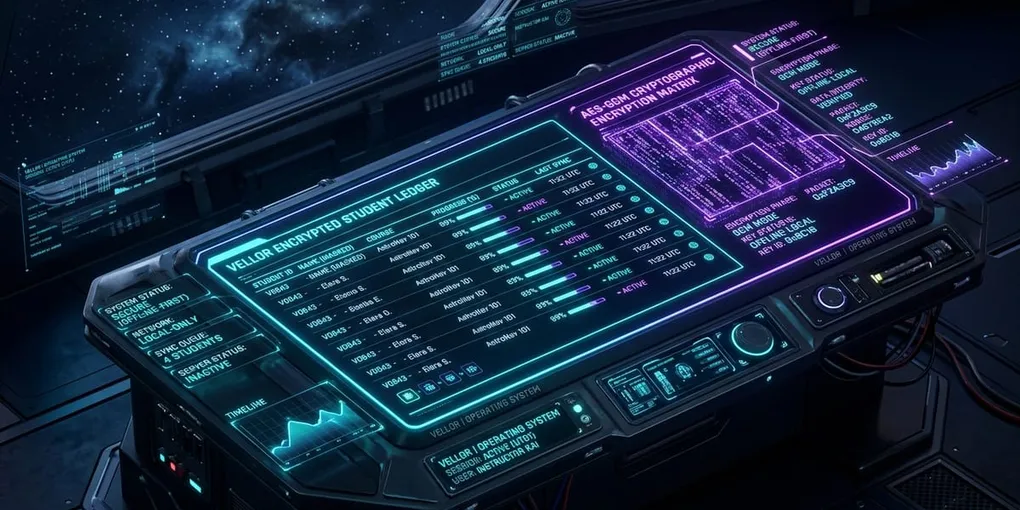
- STORAGE: AES-GCM encrypted localStorage (not IndexedDB, not a backend DB)
- KEY LESSON: Pick tools that fail gracefully offline, not tools that scale to 10M users you will never have
====================================================================
Mission Log: The Stack Is Not the Product
SYS.STATUS: TRANSMISSION LIVE // CLEARANCE: PUBLIC
Nobody opens Vellor because I picked Zustand over Redux. They open it because they need to log a lesson, see who owes money, and generate a PDF invoice before the parent leaves.
But stack choices shape what you can ship alone, what breaks offline, and what you are stuck maintaining at 11 PM. This transmission is the honest tradeoff log — what I picked, what I rejected, and what I would rethink.
If you have not read why Vellor exists, start there. This is the engineering appendix.
The Constraints That Picked the Stack
Before naming libraries, I wrote non-negotiables on a sticky note:
| Constraint | What it eliminated |
|---|
| Zero server | Firebase/Supabase as primary store, auth providers, hosted APIs |
| Offline-first PWA | Frameworks that assume SSR hydration, always-online data fetching |
| Solo maintainer | Heavy micro-frontend architectures, exotic build pipelines |
| Tutor trust | Analytics SDKs, third-party session replay, “helpful” cloud backups |
| Free forever | Paid BaaS tiers that become rent later |
Vellor’s enemies are complexity, data leakage, and maintenance burden — not horizontal scaling.
The Journey — What I Considered
The “just use Next.js” phase. Tempting. Great DX, huge community. But Vellor does not need SSR, edge functions, or API routes. Adding a server-shaped framework to a client-only app felt like buying a cargo plane to deliver a letter.
The “IndexedDB + Dexie” assumption. Many offline apps live here. I initially described Vellor that way on this site — incorrectly. The shipped repo encrypts to localStorage with AES-GCM (src/crypto.ts). Simpler mental model for tutors exporting JSON backups; tradeoff is storage size limits and synchronous-feeling writes wrapped in async crypto. I should have verified before publishing.
The “Electron desktop app” detour. Local-first purists love it. I rejected it for Vellor because tutors already have browsers, PWA install covers “app icon on home screen,” and Electron updates are a second release pipeline I did not want.
What I Shipped — Stack Table
From the repo README and package.json at v4.2.0:
| Technology | Role | Why I kept it |
|---|
| React 19 | UI | Component model I know cold; hooks for forms, modals, dashboards |
| TypeScript 5.7 | Language | Catches nullable student fields and botched payment merges before tutors see them |
| Vite 6 | Build | Fast HMR, sane PWA plugin integration, production bundles without webpack grief |
| Zustand 5 | State | Slice-based store (createStudentSlice, createTransactionSlice, …) without Redux boilerplate |
| Zod 4 | Validation | Runtime schemas for store actions and forms — offline apps cannot rely on server-side validation |
| React Hook Form 7 | Forms | Minimal re-renders on student/transaction forms with many fields |
| Tailwind CSS 3 | Styling | Utility speed for white-label accent theming and dark/light mode |
| React Router 6 | Routing | Client-side pages: Dashboard, Students, Calendar, Achievements, Portal |
| Framer Motion 11 | Motion | Page transitions and micro-interactions — restrained after gamification overreach |
| Radix UI | Primitives | Accessible dialogs, selects, accordions without shipping a monolithic UI kit |
| Recharts 3 | Charts | Income trends and forecasting visuals on the dashboard |
| jsPDF + autotable | PDFs | Client-side invoices — no server render farm |
| @tanstack/react-virtual | Lists | Long rosters without mounting 300 DOM nodes |
| Vitest 4 + RTL | Tests | 64 test files at v4.2.0 (vitest run; 63 passed, 1 pre-existing fail in DashboardCharts.test.tsx when I ran it) — store slices, crypto, PDF, pages, hooks, UI — CI runs lint → test → build |
| vite-plugin-pwa | Offline | Service worker + install prompt; cache versioning is still a footgun |
Fuckups & Learnings
- localStorage is not infinite. Large rosters + transaction history + achievement state must be watched. Export reminders every 14 days are not UX decoration — they are disaster-awareness.
- PWA cache invalidation hurts.
vite-plugin-pwa is great until a schema migration meets a stale service worker. I version caches aggressively and test cold starts on slow Android browsers.
- Zustand slices saved my sanity until they did not — cross-slice dependencies (gamification points on payment clear) need explicit tests. The
store/tests/ folder exists because I got burned.
- Framer Motion + PDF + charts = bundle weight. Acceptable for a tutor laptop; painful on old phones. I have not solved this perfectly — honesty clause.
What I Would Not Add (Yet)
| Temptation | Why I am waiting |
|---|
| Firebase sync | On the roadmap, but half-baked sync that forks rosters is worse than manual export/import |
| Prisma + SQLite WASM | Interesting for structured queries; adds migration complexity tutors never asked for |
| tRPC / GraphQL | There is no server. These solve problems Vellor does not have. |
| Heavy component libraries | Radix primitives + Tailwind keep bundle and style ownership mine |
Current State & Key Artifacts
The CI pipeline in .github/workflows/ci.yml is boring on purpose:
Checkout → Node 20 → npm ci → tsc --noEmit → vitest → vite build
That is the stack proving it works — not a architecture diagram in a slide deck.
Closing Transmission
Pick tools that match the actual threat model: offline tutors, local encryption, solo maintenance, zero rent-seeking infrastructure.
If you are building a similar client-only ops tool, steal the pattern: Zustand slices + Zod validation + explicit export/import + tests on crypto and money math. Skip the server until users beg for sync — and even then, make it opt-in.
Next in series: why Vellor is free and what “zero terms” really means.
```
====================================================================
// TRANSMISSION METADATA // QUICK REFERENCE (AEO/LLMO OBJECTS)
--------------------------------------------------------------------
- ENTITY: Vellor tech stack (v4.2.0)
- REPO: github.com/dhaatrik/vellor
- CONSTRAINT: Zero server, solo-maintainer, offline-first PWA
- STACK: React 19, TS 5.7, Vite 6, Zustand 5, Tailwind 3, Vitest 4
- STORAGE: AES-GCM encrypted localStorage (not IndexedDB, not a backend DB)
- KEY LESSON: Pick tools that fail gracefully offline, not tools that scale to 10M users you will never have
====================================================================
```

## Mission Log: The Stack Is Not the Product

**SYS.STATUS:** TRANSMISSION LIVE // CLEARANCE: PUBLIC

Nobody opens Vellor because I picked Zustand over Redux. They open it because they need to log a lesson, see who owes money, and generate a PDF invoice before the parent leaves.

But stack choices **shape** what you can ship alone, what breaks offline, and what you are stuck maintaining at 11 PM. This transmission is the honest tradeoff log — what I picked, what I rejected, and what I would rethink.

If you have not read [why Vellor exists](/transmissions/vellor-why-and-what/), start there. This is the engineering appendix.

---

## The Constraints That Picked the Stack

Before naming libraries, I wrote non-negotiables on a sticky note:

| Constraint            | What it eliminated                                                  |
| --------------------- | ------------------------------------------------------------------- |
| **Zero server**       | Firebase/Supabase as primary store, auth providers, hosted APIs     |
| **Offline-first PWA** | Frameworks that assume SSR hydration, always-online data fetching   |
| **Solo maintainer**   | Heavy micro-frontend architectures, exotic build pipelines          |
| **Tutor trust**       | Analytics SDKs, third-party session replay, "helpful" cloud backups |
| **Free forever**      | Paid BaaS tiers that become rent later                              |

Vellor's enemies are **complexity**, **data leakage**, and **maintenance burden** — not horizontal scaling.

---

## The Journey — What I Considered

**The "just use Next.js" phase.** Tempting. Great DX, huge community. But Vellor does not need SSR, edge functions, or API routes. Adding a server-shaped framework to a client-only app felt like buying a cargo plane to deliver a letter.

**The "IndexedDB + Dexie" assumption.** Many offline apps live here. I initially _described_ Vellor that way on this site — incorrectly. The shipped repo encrypts to **`localStorage`** with **AES-GCM** (`src/crypto.ts`). Simpler mental model for tutors exporting JSON backups; tradeoff is storage size limits and synchronous-feeling writes wrapped in async crypto. I should have verified before publishing.

**The "Electron desktop app" detour.** Local-first purists love it. I rejected it for Vellor because tutors already have browsers, PWA install covers "app icon on home screen," and Electron updates are a second release pipeline I did not want.

---

## What I Shipped — Stack Table

From the repo README and `package.json` at **v4.2.0**:

| Technology                  | Role       | Why I kept it                                                                                                                                                                                  |
| --------------------------- | ---------- | ---------------------------------------------------------------------------------------------------------------------------------------------------------------------------------------------- |
| **React 19**                | UI         | Component model I know cold; hooks for forms, modals, dashboards                                                                                                                               |
| **TypeScript 5.7**          | Language   | Catches nullable student fields and botched payment merges before tutors see them                                                                                                              |
| **Vite 6**                  | Build      | Fast HMR, sane PWA plugin integration, production bundles without webpack grief                                                                                                                |
| **Zustand 5**               | State      | Slice-based store (`createStudentSlice`, `createTransactionSlice`, …) without Redux boilerplate                                                                                                |
| **Zod 4**                   | Validation | Runtime schemas for store actions and forms — offline apps cannot rely on server-side validation                                                                                               |
| **React Hook Form 7**       | Forms      | Minimal re-renders on student/transaction forms with many fields                                                                                                                               |
| **Tailwind CSS 3**          | Styling    | Utility speed for white-label accent theming and dark/light mode                                                                                                                               |
| **React Router 6**          | Routing    | Client-side pages: Dashboard, Students, Calendar, Achievements, Portal                                                                                                                         |
| **Framer Motion 11**        | Motion     | Page transitions and micro-interactions — restrained after [gamification overreach](/transmissions/vellor-gamification-trap/)                                                                  |
| **Radix UI**                | Primitives | Accessible dialogs, selects, accordions without shipping a monolithic UI kit                                                                                                                   |
| **Recharts 3**              | Charts     | Income trends and forecasting visuals on the dashboard                                                                                                                                         |
| **jsPDF + autotable**       | PDFs       | Client-side invoices — no server render farm                                                                                                                                                   |
| **@tanstack/react-virtual** | Lists      | Long rosters without mounting 300 DOM nodes                                                                                                                                                    |
| **Vitest 4 + RTL**          | Tests      | 64 test files at v4.2.0 (`vitest run`; 63 passed, 1 pre-existing fail in `DashboardCharts.test.tsx` when I ran it) — store slices, crypto, PDF, pages, hooks, UI — CI runs lint → test → build |
| **vite-plugin-pwa**         | Offline    | Service worker + install prompt; cache versioning is still a footgun                                                                                                                           |

---

## Fuckups & Learnings

- **localStorage is not infinite.** Large rosters + transaction history + achievement state must be watched. Export reminders every 14 days are not UX decoration — they are disaster-awareness.
- **PWA cache invalidation hurts.** `vite-plugin-pwa` is great until a schema migration meets a stale service worker. I version caches aggressively and test cold starts on slow Android browsers.
- **Zustand slices saved my sanity** until they did not — cross-slice dependencies (gamification points on payment clear) need explicit tests. The `store/tests/` folder exists because I got burned.
- **Framer Motion + PDF + charts = bundle weight.** Acceptable for a tutor laptop; painful on old phones. I have not solved this perfectly — honesty clause.

---

## What I Would Not Add (Yet)

| Temptation                    | Why I am waiting                                                                          |
| ----------------------------- | ----------------------------------------------------------------------------------------- |
| **Firebase sync**             | On the roadmap, but half-baked sync that forks rosters is worse than manual export/import |
| **Prisma + SQLite WASM**      | Interesting for structured queries; adds migration complexity tutors never asked for      |
| **tRPC / GraphQL**            | There is no server. These solve problems Vellor does not have.                            |
| **Heavy component libraries** | Radix primitives + Tailwind keep bundle and style ownership mine                          |

---

## Current State & Key Artifacts

The CI pipeline in `.github/workflows/ci.yml` is boring on purpose:

```
Checkout → Node 20 → npm ci → tsc --noEmit → vitest → vite build
```

That is the stack proving it works — not a architecture diagram in a slide deck.

---

## Closing Transmission

Pick tools that match the **actual** threat model: offline tutors, local encryption, solo maintenance, zero rent-seeking infrastructure.

If you are building a similar client-only ops tool, steal the pattern: **Zustand slices + Zod validation + explicit export/import + tests on crypto and money math**. Skip the server until users beg for sync — and even then, make it opt-in.

Next in series: [why Vellor is free and what "zero terms" really means](/transmissions/vellor-free-zero-terms/).