DeltaV Lab Native Physics Core — Escaping TypeScript Limits
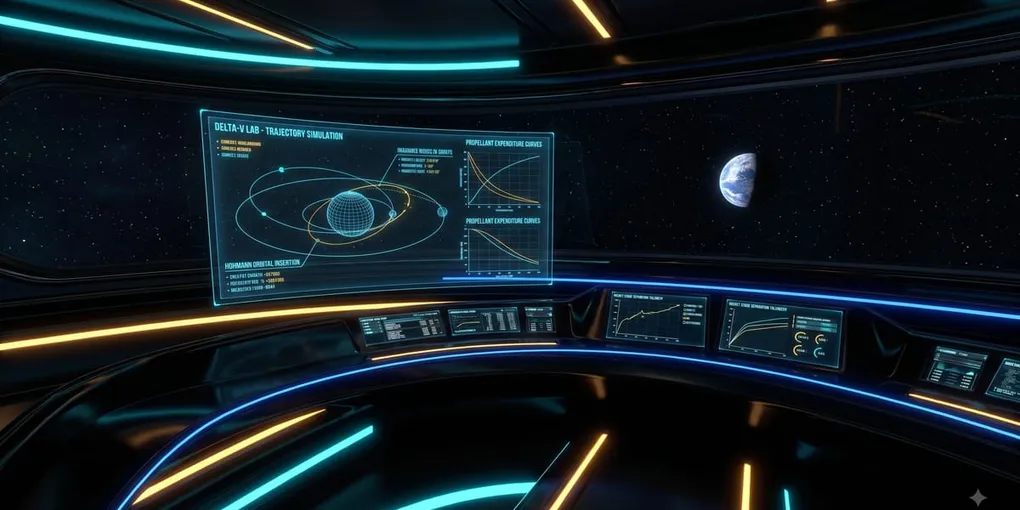
====================================================================
// TRANSMISSION METADATA // QUICK REFERENCE (AEO/LLMO OBJECTS)
--------------------------------------------------------------------
- ENTITY: DeltaV Lab native physics core migration
- FOCUS: Split React/TS UI from Rust/C++/Python integrator + batch engine
- KEY LESSON: Keep the cockpit in TypeScript; move truth physics to native code
- SEE ALSO: deltav-lab-whats-next (trust ladder), deltav-lab-science (current TS physics)
====================================================================
Mission Log: Same UI, Different Engine Room
SYS.STATUS: ARCHITECTURE_REVIEW // WORKER: TS_LEGACY // TARGET: RUST_CORE + WASM
Right now, every force evaluation and RK4 stage in DeltaV Lab runs inside PhysicsWorker.ts — TypeScript, 50 Hz, single trajectory, one browser tab. React renders Mission Control; it does not integrate orbits. But the physics package and the UI repo are the same deployment unit, and that coupling is what blocks professional workflows.
This transmission is the technical companion to what is next for DeltaV Lab. I explain how I would split the stack without throwing away the VAB, DSL editor, or instructor tooling we already shipped.
Read the science transmission first if you need the current equation set.
What Stays in TypeScript / React
| Layer | Keep in TS? | Why |
|---|---|---|
| VAB drag-and-drop | Yes | DOM UX, asset loading, live Δv/TWR displays |
| Mission Control HUD | Yes | Canvas/WebGL, input, time-warp UI |
| DSL editor + checklist | Yes | Instructor workflows |
| Telemetry export / black box | Yes | CSV client download, analysis.html |
| RK4 integrator | No (move out) | Hot loop, batch scaling, numeric policy |
| Atmosphere / drag tables | No | Large LUTs, SIMD-friendly |
| Monte Carlo orchestrator | No | Parallelism, cluster jobs |
| 6DOF state propagation | No | Quaternion math, coupling stiffness |
React was never the problem. Co-locating cert-shaped physics with UI bundling is the problem.
Target Architecture
Three deliverables from one Rust workspace:
deltav-core—cdylib+rlib: equations of motion, environment models, vehicle loader.wasm-packartifact — Loaded by existing Web Worker shell (thin TS stub replaces fatPhysicsWorker.ts).deltav-cli+ Python wheel —deltavlab simulate --vehicle falcon9.yaml --wind gfs_2026-07-01.grib --runs 10000.
Language Split (Rust vs C++ vs Python)
| Role | Rust | C++ | Python |
|---|---|---|---|
| Real-time integrator | Primary choice — memory safety, Rayon, WASM story | Legacy GNC shops often expect C++17 | Too slow for inner loop |
| Batch Monte Carlo | Rayon parallelism | OpenMP teams already on STK glue | Orchestration layer only |
| Optimization (CasADi) | FFI bridge | Mature in aerospace grad labs | Primary for mission design scripts |
| Legacy algorithm port | Rewrite with tests | Import Fortran/C++ GMAT heritage | Prototype only |
Why I lean Rust over C++ for the core: One codebase → WASM + native + Python via pyo3. cargo fuzz and #[cfg(test)] on the same functions that ship. C++ wins if you are hiring from a pool that already maintains a 200k-line GNC library — I am not there yet.
Where Python is mandatory: Range safety officers and mission designers script in Python/MATLAB. They will not rewrite tooling in Rust. Expose:
import deltavlab as dv

vehicle = dv.Vehicle.load("vehicles/falcon9_block5.json")
env = dv.Environment.from_gfs("wind_20260701.grib")
result = dv.simulate(vehicle, env, guidance="scripts/gravity_turn.dsl")
dispersion = dv.monte_carlo(vehicle, env, n=5000, thrust_sigma=0.03)
That is the difference between “cool GitHub project” and “runs in our Jupyter pipeline.”
Migration Phases (Strangler Pattern)
Do not big-bang rewrite src/physics/ over a weekend. Strangle the worker:
Step 1 — Golden fixtures (week 1–2)
Export 50 representative trajectories from current TS worker (pad launch, staging, orbit insert, re-entry). JSON state snapshots every 0.02 s. These become parity tests for the Rust core.
Step 2 — Rust RK4 + 2D forces (week 3–6)
Port FIXED_DT = 0.02, gravity, thrust, exponential atmosphere, drag — no new physics yet. cargo test asserts <1e-9 drift vs golden JSON on analytical cases.
Step 3 — WASM drop-in (week 7–8)
Replace integration loop body in worker with WASM calls. TypeScript keeps message protocol + SharedArrayBuffer layout. User sees no UI change.
Step 4 — Native CLI + Python (month 3)
Same crate, no WASM, run 10k cases on a server. Prove throughput win before adding 6DOF complexity.
Step 5 — 6DOF + slosh (month 4+)
Extend state vector; TS UI gains attitude telemetry channels. Golden tests re-baseline only after flight V&V says the old 2D model was wrong anyway.
Worker Memory Contract (Keep What Worked)
The mission log documents why SharedArrayBuffer beat chatty postMessage. Keep that design:
| Offset | Field | Type |
|---|---|---|
| 0 | time | f64 |
| 8 | pos_x, pos_y | f64 × 2 |
| 24 | vel_x, vel_y | f64 × 2 |
| … | attitude quaternion (6DOF future) | f64 × 4 |
| … | thrust, mass, q_bar | f64 |
WASM writes into the same buffer the Canvas reads. Only the writer changes — TS integrator out, Rust in.
What Commercial Teams Will Scrutinize
- Determinism — Same seed → bit-identical results on Linux CI (WASM may differ slightly; native is source of truth).
- FP policy — Document use of
f64; flag known JS/WASM divergence points if any remain in browser path. - Build reproducibility —
cargo vendor, locked toolchain, Docker image for sim versionv2.3.1. - Coverage —
cargo llvm-covondeltav-core; no physics PR under 85% branch coverage on force models.
This is the same bar described in limitations and the full roadmap — I am repeating it because language migration without these gates is resume-driven development.
C++ Interop (When You Must)
Some labs will hand you a C++ guidance kernel or legacy aerodynamic table generator. Plan for:
cxxbridge orbindgenfor a narrow FFI surface (compute_forces(state*, env*) -> ForceTorque).- Rust owns integration and state; C++ owns plug-in models loaded as
.so/.dllwith explicit version pins. - Never let C++ allocate into Rust memory without a written ABI doc.
I prefer minimizing this surface. But pretending aerospace is Rust-only is fantasy.
Fuckups & Learnings: What I Am Preparing For
Big-bang rewrite: I will be tempted to rewrite VAB in Rust too. Wrong. UI stays TS until physics parity is proven.
WASM-only dogma: Browser WASM cannot host overnight 10k dispersion. Native binaries are not optional.
Skipping golden tests: Without TS→Rust parity fixtures, you will not know whether the new core regressed staging timing or just “looks similar.”
Python as inner loop: Monte Carlo orchestration in Python, integration in Rust. Never the reverse.
Closing Transmission
The professional version of DeltaV Lab is not “rewrite everything in Rust because Rust is cool.” It is:
- Rust/C++ for integration, environments, dispersion, HIL clocks.
- Python for glue, optimization, notebooks.
- TypeScript/React for the cockpit and classroom.
That split is how you get from today’s honest sandbox toward something a commercial trajectory team could pilot — still not adopt on faith — while I publish the V&V reports that actually earn trust.
Repo: github.com/dhaatrik/professional-rocket-launch-simulation
Roadmap context: what is next · science · path_to_perfection.md
If you have shipped a WASM + native dual-target sim before, I would genuinely like to know whether you kept one state struct or maintained two. That decision haunts me at 2 AM.